


Miss Hala Ali

News & Insights

Expert perspectives on eye health, surgical advances, and patient care from Miss Hala Ali

What the Latest Advances in Cataract and Laser Eye Surgery Mean for Patients
Miss Hala Ali attending a session at the ESCRS Congress
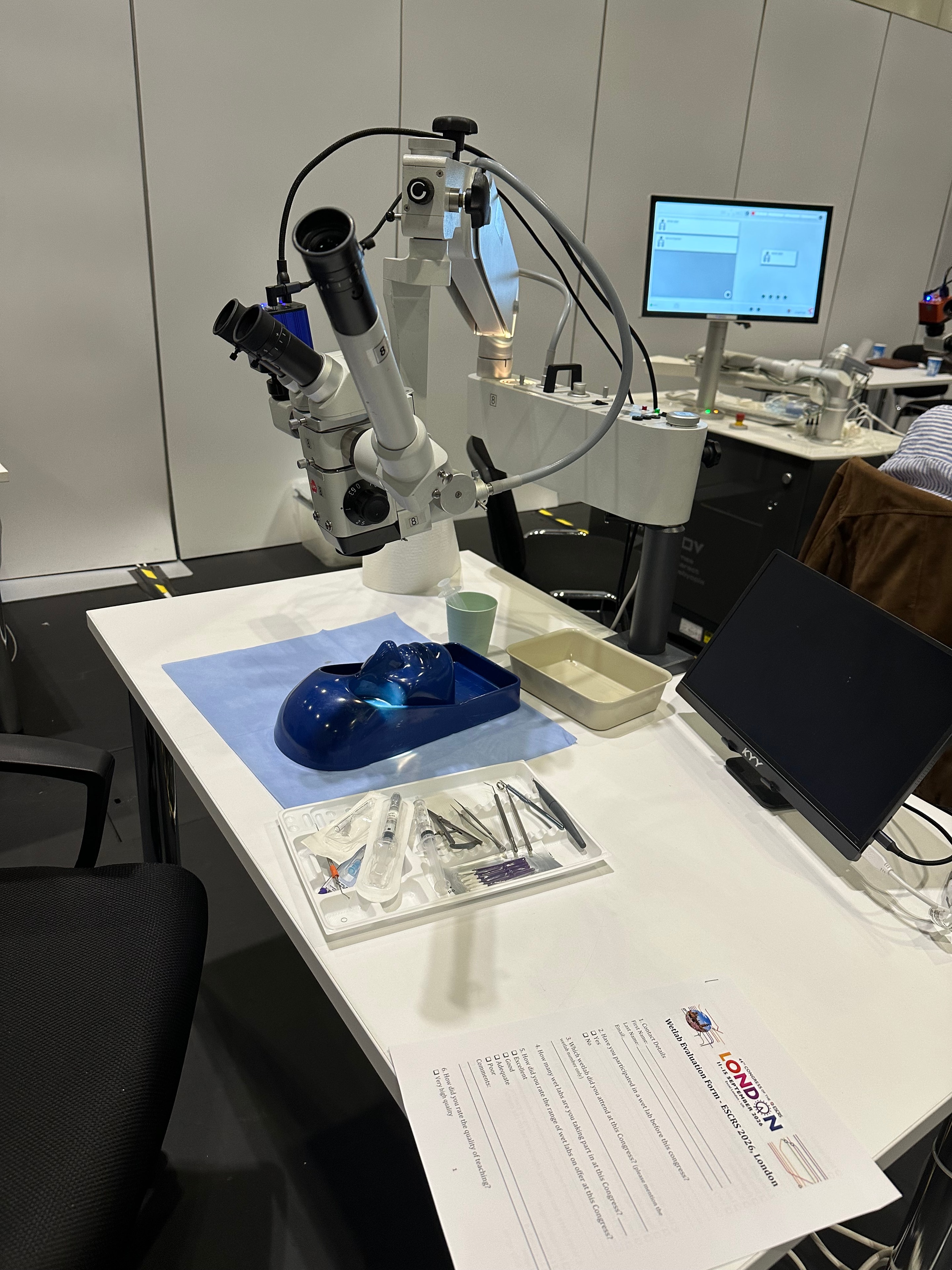
Hands-on wetlab session with the latest laser refractive surgery technology
Surgical Advances5 min read

What the Latest Advances in Cataract and Laser Eye Surgery Mean for Patients

This month I attended the European Society of Cataract and Refractive Surgeons (ESCRS) Annual Congress, held this year in London. It is one of the most important gatherings in Ophthalmology, bringing together thousands of eye surgeons from across the world to share research, clinical outcomes and emerging techniques. I also had the opportunity to take part in a hands-on wetlab session using the latest laser technology for refractive surgery. Here is what I took away, and why it is relevant to anyone considering cataract surgery, lens replacement or laser vision correction.

Precision in lens replacement surgery has taken a significant step forward. One of the clearest themes at the congress was the growing role of artificial intelligence in planning cataract and refractive lens exchange procedures. New AI-driven formulas are now able to predict the ideal intraocular lens power with a level of accuracy that was simply not possible a few years ago. For patients choosing a premium lens, whether a multifocal lens to reduce dependence on glasses or a toric lens to correct astigmatism, this means a higher chance of achieving the target vision first time. Fewer patients are likely to need a secondary enhancement procedure, and more can expect to be free of glasses for most daily activities after surgery.

There was also a great deal of discussion around new options for presbyopia, the gradual loss of near focus that affects almost everyone from their mid-forties onwards. Extended depth of focus (EDOF) lenses continue to improve, and newer designs are offering a wider, more natural range of vision with fewer visual disturbances such as halos or glare at night. For patients who are not yet ready for lens surgery, there are also advances in corneal laser treatments that can address presbyopia while preserving the option of lens surgery later. These developments mean that more patients now have a realistic route to reduced glasses dependence, regardless of their age or starting prescription.

The wetlab sessions I took part in focused on a new generation of femtosecond laser, excimer laser and solid-state ablation laser plateforms for laser refractive surgery. Practising on these systems gave me direct experience of how the technology has evolved in terms of speed, precision and the ability to customise treatment to the individual eye. The latest platforms use more sophisticated eye-tracking and can deliver treatment profiles tailored to the unique optical characteristics of each patient's cornea. For suitable candidates, this translates into sharper, more stable vision after laser eye surgery and a reduced risk of side effects such as dry eye or night-vision disturbance.

If you are considering cataract surgery, lens replacement for presbyopia or laser vision correction, the advances discussed at this year's congress are directly relevant to the options available to you now. I am committed to bringing the most current evidence and techniques to my practice, and I am happy to discuss which approach may be most appropriate for your individual circumstances. If you would like to arrange a consultation, please do get in touch. There is no obligation, and an initial assessment is simply an opportunity to understand your options clearly.

The Benefits of Modern Cataract Surgery: What Patients Need to Know
Cataract Surgery5 min read

The Benefits of Modern Cataract Surgery: What Patients Need to Know

Cataract surgery has undergone a remarkable transformation over the past two decades. Today's minimally invasive phacoemulsification technique, combined with premium intraocular lens options, means many patients achieve better vision after surgery than they had even before their cataract developed.

The procedure itself typically takes around 20–30 minutes and is performed under local anaesthetic as a day case. Most patients notice a significant improvement in their vision within 24 hours, with full recovery usually complete within four to six weeks.

One of the most exciting developments in recent years is the range of premium lens implants now available. Multifocal lenses can provide clear vision at distance, intermediate and near ranges, potentially reducing or eliminating the need for glasses altogether. Extended depth of focus (EDOF) lenses offer a continuous range of vision with excellent contrast sensitivity, while toric lenses correct astigmatism at the same time as treating the cataract.

A further advance worth noting is femtosecond laser-assisted cataract surgery (FLACS). This technique uses a precisely programmed laser to perform several of the key steps in the procedure, including the initial incisions, the circular opening in the lens capsule, and the softening of the cataract itself. The result is a highly reproducible and accurate operation that can be particularly beneficial for patients with complex cataracts or those choosing premium lens implants, where precise positioning is critical to achieving the best visual outcome.

If you are experiencing blurred or cloudy vision, increased glare, or difficulty reading, it may be worth seeking a specialist opinion. Early assessment allows us to plan the most appropriate treatment and discuss which lens option best suits your lifestyle and visual needs.

How to Protect Your Eyesight as You Age: Expert Advice
Eye Health4 min read

How to Protect Your Eyesight as You Age: Expert Advice

Our eyes change throughout our lives, and many of the conditions that affect vision in later years are influenced by lifestyle factors we can address today. Understanding these risks and taking simple preventive steps can make a meaningful difference to your long-term eye health.

UV exposure is one of the most significant and modifiable risk factors for several eye conditions, including cataracts and age-related macular degeneration. Wearing good-quality sunglasses that block 100% of UVA and UVB rays whenever you are outdoors, even on overcast days, is one of the most effective things you can do to protect your eyes.

Diet also plays an important role. Foods rich in lutein and zeaxanthin, such as leafy green vegetables, eggs and sweetcorn, help protect the macula. Omega-3 fatty acids found in oily fish support the tear film and may reduce the risk of dry eye disease. Staying well hydrated and avoiding smoking are equally important.

Regular eye examinations are essential, even if you feel your vision is unchanged. Many conditions, including glaucoma and diabetic eye disease, can progress silently before symptoms appear. If you have a family history of eye disease, are over 60, or have diabetes or high blood pressure, more frequent monitoring is advisable. Do not wait for symptoms to develop before seeking a review.

Understanding Corneal Health and When to Seek Specialist Care
Corneal Health6 min read

Understanding Corneal Health and When to Seek Specialist Care

The cornea, the clear dome-shaped surface at the front of the eye, plays a critical role in focusing light and protecting the inner structures of the eye. When the cornea is affected by disease or injury, it can have a profound impact on vision and quality of life.

Keratoconus is one of the most common corneal conditions seen in specialist practice. In this condition, the cornea gradually thins and bulges forward into a cone shape, causing progressive distortion of vision. It typically presents in the teens or early twenties and, if detected early, can often be halted with corneal collagen cross-linking (CXL). Specialist contact lenses or, in more advanced cases, corneal transplantation may be required to restore functional vision.

Corneal dystrophies are a group of inherited conditions that cause abnormal deposits or structural changes within the cornea. Fuchs' endothelial dystrophy, for example, affects the innermost layer of the cornea and can lead to blurred vision, particularly in the mornings. Modern surgical techniques such as DSAEK and DMEK allow selective replacement of only the affected layer, resulting in faster recovery and better visual outcomes than traditional full-thickness transplants.

You should seek specialist assessment if you experience persistent blurring or distortion of vision, increased sensitivity to light or glare, recurrent eye infections or inflammation, or if your optometrist has noted changes to your corneal shape or clarity. Early diagnosis and appropriate management can preserve vision and, in many cases, avoid the need for more complex surgery.

Have a question about your eye health?

Miss Ali welcomes new patients at the Parkside Suite, Frimley Park Hospital. To arrange a consultation, please get in touch.

Book a Consultation